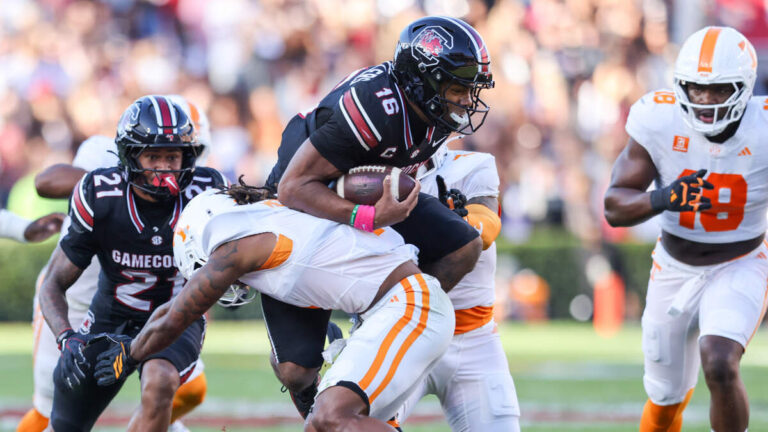

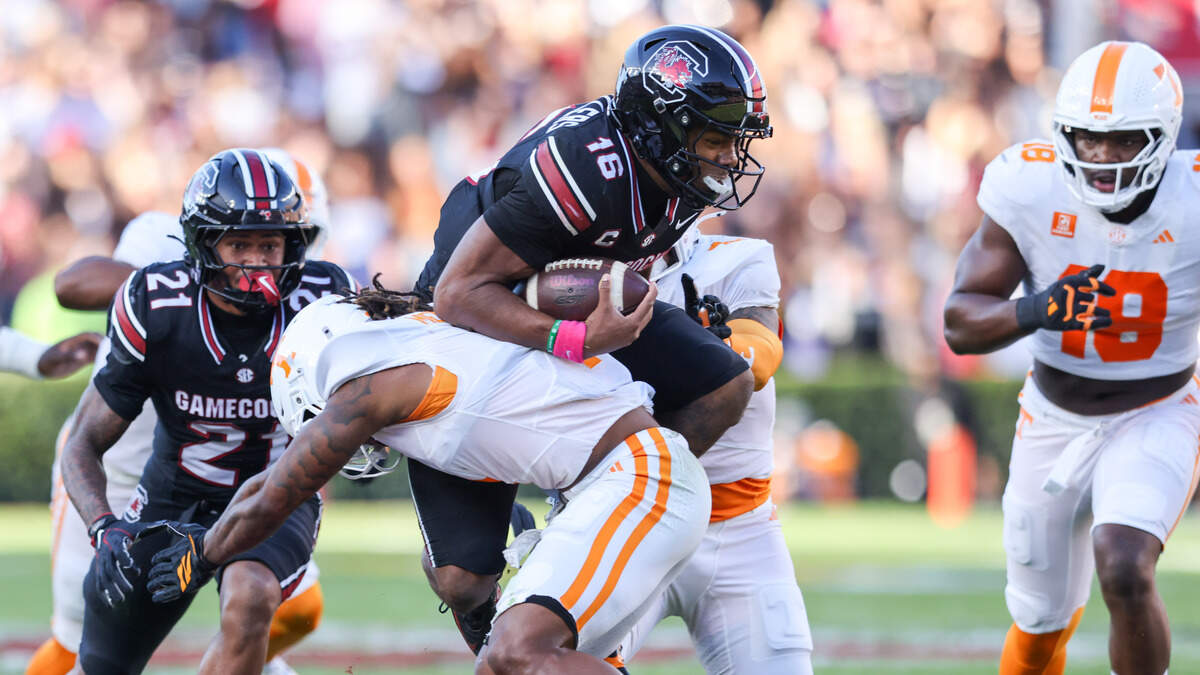
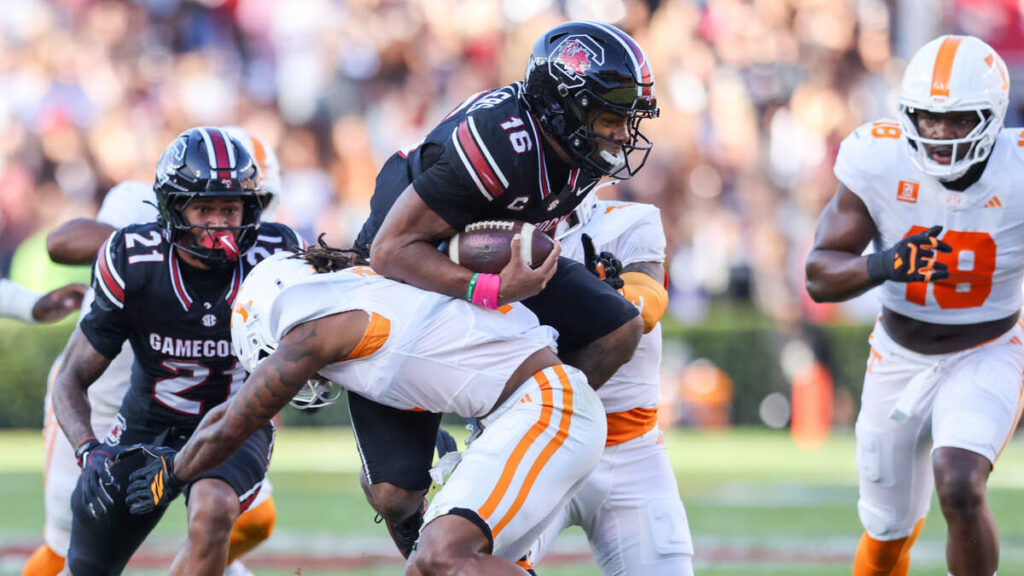
South Carolina quarterback LaNorris Sellers (16) gets tackled during the first half of the Gamecocks’ game against Tennessee in Columbia on Saturday, October 24, 2026.
 0
 0
SOUTH CAROLINA 27, TENNESSEE 24
South Carolina’s Homecoming was supposed to be a celebration. Instead, it became a test of just how much heartbreak a team can endure before it finally learns how to finish against Tennessee.
For a moment, it looked like the Gamecocks were headed toward another familiar ending: a promising start, a double-digit lead slipping away and another Saturday spent wondering what went wrong. Tennessee came into Williams-Brice Stadium ranked No. 11, weathered South Carolina’s opening punch and turned a 14-point deficit into a seven-point fourth-quarter advantage.
But this time, South Carolina refused to let the story end there.
With the Homecoming crowd watching, quarterback LaNorris Sellers dragged the Gamecocks back into the fight, the defense delivered a season-defining takeaway, and Malik Orsan sent a 48-yard field goal through the uprights as time expired. South Carolina walked away with a 27-24 victory on Oct. 24, turning a potentially devastating afternoon into one of the most dramatic wins of its season.
It was messy. It was tense. It was emotional. And for a team that had spent recent weeks struggling to close games, it was exactly the kind of finish it needed.
Nearly Another Heartbreak for South Carolina
South Carolina opened the afternoon looking like the team its fans had been waiting to see.
The Gamecocks scored on their first two possessions, striking quickly and putting Tennessee on its heels. Sellers connected with Mazeo Bennett Jr. for a 17-yard touchdown before breaking free for a 31-yard scoring run. In a little more than five minutes of game action, South Carolina had built a 14-0 lead and given the Homecoming crowd every reason to believe.
The energy was real. The opportunity was there. For a team seeking momentum in SEC play, the opening stretch felt like a statement.
Then the game changed.
Tennessee did not panic. The Volunteers leaned on running back DeSean Bishop and began grinding away at South Carolina’s defense. Their response was not built on one spectacular play, but on patience, physicality and the willingness to make the Gamecocks defend snap after snap.
Tennessee’s first touchdown came at the end of an 18-play, 75-yard drive that consumed more than nine minutes. Bishop finished the possession with a one-yard touchdown run. The Volunteers followed it with another scoring drive, tying the game at 14 after DaSaahn Brame punched in a one-yard touchdown.
South Carolina had gone from controlling the afternoon to watching its advantage disappear.
The Gamecocks briefly reclaimed the lead when Orsan connected on a 22-yard field goal. But Tennessee answered with another touchdown before halftime, as wide receiver Mike Matthews scored on an eight-yard run out of the Wildcat formation.
A 14-0 South Carolina lead had become a 21-17 Tennessee advantage.
The second quarter exposed a problem that has haunted teams across college football: an explosive start means very little if the defense cannot get off the field and the offense cannot maintain control. South Carolina had shown what it could be when everything clicked. Tennessee showed how quickly that can unravel when a team loses its grip on momentum.
Tennessee Had the Game Where It Wanted It
The third quarter brought a defensive stalemate, with neither team finding the end zone. Tennessee entered the fourth quarter still holding the lead, and a 37-yard field goal from Cooper Ranvier extended the advantage to 24-17.
The Volunteers had done the difficult part. They had recovered from an early deficit, controlled the tempo for long stretches and put themselves in position to leave Columbia with a ranked road win.
South Carolina, meanwhile, was running out of time.
The Gamecocks needed a response that went beyond another encouraging drive or a few yards gained. They needed a possession that changed the outcome.
And when the decisive opportunity arrived, Tennessee helped open the door.
With roughly three and a half minutes remaining, the Volunteers faced fourth-and-1 on South Carolina’s 39-yard line. Rather than extend the possession, Tennessee was stopped short. The decision left the Gamecocks alive and gave Sellers the chance to do what he had done throughout the afternoon: create something when the situation demanded it.
That failed conversion became one of the game’s defining moments. Tennessee had the lead and a chance to keep the ball away from South Carolina. Instead, the Volunteers handed the Gamecocks an opportunity to tie the game.
Against a quarterback as dangerous with his legs as Sellers, leaving that opportunity unanswered was a costly gamble.
LaNorris Sellers Refused to Let the Moment Pass for South Carolina
Sellers’ afternoon was not flawless, and that is part of what made the finish meaningful.
He had helped South Carolina jump out to its early lead, but he also threw an interception that allowed Tennessee to climb back into the game. The performance was a reminder of the fine line between the quarterback who sparks an offense and the quarterback whose mistakes give an opponent life.
Yet when the Gamecocks needed their leader most, Sellers delivered.
South Carolina moved 61 yards on six plays, setting up a third-and-goal situation that would become the emotional center of the afternoon. Sellers took the ball toward the goal line, absorbed contact from two defenders and fought to extend it across the plane near the pylon.
The touchdown was reviewed and upheld. With 1:17 remaining, the score was tied at 24.
Sellers finished with 210 passing yards, one passing touchdown, two rushing touchdowns and 96 yards on the ground. His ability to threaten Tennessee both through the air and as a runner forced the Volunteers to defend the entire field.
The tying touchdown was not just a highlight. It was a response to adversity, a moment when the Gamecocks needed their quarterback to turn pressure into production.
South Carolina had been here before this season: in position to win, only to watch the game slip away. This time, Sellers gave his team a chance to finish.
But the offense had done only half the work. The defense still needed to keep Tennessee from answering.
Dylan Stewart Delivered When It Mattered Most
Tennessee got the ball back with an opportunity to reclaim control. There was still time for the Volunteers to put together a drive, move into scoring range and spoil South Carolina’s Homecoming.
Instead, Dylan Stewart changed the game.
With 33 seconds remaining, the South Carolina edge rusher got to Tennessee quarterback George MacIntyre and forced a fumble. Defensive tackle Tomiwa Durojaiye recovered the loose ball at Tennessee’s 34-yard line, placing the Gamecocks within range of a potential game-winning kick.
It was the kind of defensive play that does more than stop a possession. It changes the entire emotional temperature of a stadium.
Stewart had been battling Tennessee’s protection throughout the game, and the decisive play arrived when South Carolina could least afford to miss its chance. Durojaiye’s recovery ensured the effort would not be wasted.
The timing was everything. The Gamecocks had just fought their way back into a tie, and now the defense had created an opportunity to win outright rather than settle for overtime.
For Tennessee, the fumble was the worst possible response to the momentum shift. The Volunteers had already survived one comeback attempt. They could not survive the second.
Malik Orsan Put the Finishing Touch on Homecoming
South Carolina did not need another touchdown. It needed composure.
The Gamecocks used the final seconds to position Orsan for a 48-yard field goal, allowing the clock to wind down before sending the kicker onto the field.
Then came the kick.
Orsan connected as time expired, sending the ball through the uprights and South Carolina into celebration. The 27-24 victory was secured, and fans poured onto the field to celebrate a win that had seemed uncertain just minutes earlier.
In a game defined by missed chances, costly mistakes and shifting momentum, Orsan provided the cleanest possible ending.
His field goal also underscored an important truth about close football games: the final moment often belongs to the player who can block out everything that came before it. The early lead, the blown advantage, the fourth-quarter deficit and the pressure of a ranked opponent all became background noise. The only thing that mattered was the kick.
Orsan delivered.
The Numbers Tell a More Complicated Story
South Carolina finished with 344 total yards, while Tennessee recorded 320. The Gamecocks produced 210 passing yards and 134 rushing yards; Tennessee leaned more heavily on the ground game, finishing with 184 rushing yards and 136 through the air.
Bishop was a major part of Tennessee’s offensive effort, carrying the ball 32 times for 120 yards and a touchdown. His workload helped the Volunteers control possession for 34 minutes and 12 seconds, compared with South Carolina’s 25:48.
The time-of-possession advantage explains how Tennessee recovered from its early deficit. The Volunteers sustained drives, kept their defense off the field and limited South Carolina’s opportunities to build on its fast start.
But possession alone does not win games. Tennessee also committed 12 penalties for 90 yards, while South Carolina was flagged nine times for 71 yards. The Volunteers’ inability to consistently avoid costly mistakes made an already difficult road environment more challenging.
South Carolina also had to overcome its own inconsistency. Sellers threw an interception, and the Gamecocks surrendered their early two-touchdown lead. The difference was what happened at the end: South Carolina found a tying touchdown, forced a turnover and made the winning kick.
The game was not a story of one team playing perfectly. It was a story of which team made the final sequence count.
What This Win Says About South Carolina
This victory matters because of what came before it.
South Carolina entered the game after a difficult stretch that included losses in which it had struggled to protect leads. The Gamecocks had reason to question whether they could sustain strong stretches of play long enough to finish against quality opponents.
Tennessee gave them another opportunity to confront that question. The Gamecocks started fast, lost control, fell behind and then faced the possibility of another painful home defeat.
This time, they found a different ending.
That does not erase the mistakes. South Carolina still has to become more consistent over four quarters, especially when defending long drives and protecting a lead. But the finish offers something that cannot be manufactured in practice: evidence that the team can respond under pressure.
The win also marks South Carolina’s second straight victory over a ranked opponent after defeating Florida two weeks earlier. At 4-3 overall and 2-3 in SEC play, the Gamecocks have given themselves a chance to build momentum rather than let a difficult stretch define the season.
The challenge now is to make this a turning point, not simply a memorable Saturday.
What Tennessee Must Take From the Loss
For Tennessee, the defeat is painful because the Volunteers did enough to put themselves in position to win.
They overcame a 14-point deficit, produced a lengthy touchdown drive, controlled possession and entered the final minutes with a seven-point lead. Bishop’s 120 rushing yards helped establish the physical identity Tennessee needed after its slow start.
But the Volunteers could not finish.
The fourth-and-1 stop gave South Carolina life. The tying touchdown put pressure back on Tennessee. The strip sack then turned a potential final possession into the setup for Orsan’s game-winning kick.
Tennessee’s loss should not obscure the resilience it showed in recovering from the early deficit. It should, however, sharpen the focus on execution in decisive situations. A team can spend most of a game recovering from mistakes and still lose because of one final mistake of its own.
The Volunteers leave Columbia at 6-2 overall and 3-2 in SEC play. Their next game is scheduled for Nov. 7 against Kentucky, giving them an open week to review a finish that slipped away.
Homecoming Became a Statement
South Carolina’s 27-24 win over No. 11 Tennessee was not a perfect performance. It was more revealing than that.
The Gamecocks showed how quickly a game can turn when discipline slips, how difficult it is to protect a lead against a capable opponent and how much a quarterback’s decision-making can shape an afternoon. They also showed what happens when an offense, defense and special teams unit each make a decisive contribution at the right moment.
Sellers brought South Carolina back. Stewart forced the turnover. Durojaiye secured the recovery. Orsan delivered the final blow.
For Tennessee, the afternoon will be remembered for the opportunity that disappeared. For South Carolina, it will be remembered for the moment the Gamecocks finally seized the ending.
Homecoming gave the fans a celebration. The finish gave the team something more valuable: a chance to believe that this season still has room to become something special.
Source: Southeastern Conference; University of Tennessee Athletics; Associated Press reporting.



About the Author