
#image_title
 1
1
 0
0
A Legacy Forged in Resistance and Reinvention
On a hill overlooking northeast Baltimore stands Morgan State University, an HBCU born not simply out of necessity, but out of defiance. Founded in 1867, just two years after the Civil War, the institution began as the Centenary Biblical Institute in the basement of a Methodist church. At a time when Black Americans were systematically denied access to education, building a school was an act of resistance.
Literacy had once been outlawed for the enslaved. Education was treated as a threat. Therefore, the creation of Morgan was revolutionary.
From the beginning, the university declared something radical: Black intellect would not be silenced. Black ambition would not be restrained. What started in a church basement became a promise — one insisting that Black Americans would claim their rightful place in the nation’s intellectual and civic life.
Renamed Morgan College in 1890 in honor of donor Lyttleton F. Morgan, the institution expanded beyond its theological roots. In 1939, the state of Maryland purchased the college. As a result, Morgan became a public institution during segregation, serving Black students who were barred from predominantly white universities.
That shift carried structural importance. It affirmed Morgan State University as Maryland’s public urban HBCU, designed to expand opportunity. By 1975, university status reflected decades of academic growth and research development.
Today, Morgan State University enrolls nearly 10,000 students. It holds a Carnegie R2 designation for high research activity. Programs span engineering, transportation, public health, architecture, and emerging technologies. Yet the university’s identity extends beyond enrollment data. Instead, it remains anchored in history and driven by a belief that preparation is power.
Like many HBCUs, Morgan’s story mirrors the broader arc of Black American progress — forged in exclusion, sustained by excellence, and still unfolding.
Alumni Who Changed the Narrative
The strength of any HBCU is measured by the lives it launches. At Morgan State University, those lives have reshaped science, business, politics, journalism, and professional sports far beyond Baltimore.
Among its most groundbreaking alumni is Valerie Thomas. Her work at NASA transformed satellite image processing systems. In addition, her invention of the illusion transmitter advanced three-dimensional imaging technology. At a time when Black women were largely excluded from aerospace research, her career expanded both innovation and representation.
Similarly, Earl G. Graves Sr. reshaped economic storytelling in America. As founder of Black Enterprise magazine, he created a national platform for Black entrepreneurship and corporate leadership. More importantly, he built infrastructure for wealth creation.
In journalism, William C. Rhoden became a leading voice examining race and labor in professional athletics. His reporting elevated national conversations about ownership and equity in sports.
Meanwhile, Parren J. Mitchell carried Morgan’s influence into Congress. As the first African American elected to the U.S. House of Representatives from Maryland, he championed minority business development and civil rights legislation.
Across laboratories, boardrooms, and legislative chambers, Morgan alumni entered institutions that once excluded them. Then they reshaped those institutions from within.
Athletically, the university’s imprint is equally significant. Willie Lanier redefined leadership at middle linebacker in the NFL. Leroy Kelly followed with a dominant career for the Cleveland Browns. Together, they reinforced Morgan State University’s reputation as a producer of elite talent.
The common thread is not fame. It is impact.
Athletic Excellence That Broke Barriers
Athletics at Morgan State University have long functioned as both competition and statement. Competing in NCAA Division I within the Mid-Eastern Athletic Conference, the Bears built programs that demanded recognition during eras when HBCU athletes were routinely overlooked.
Football remains central to the university’s identity. Under legendary coach Edward P. Hurt, Morgan became a powerhouse in the CIAA. During segregation, the Bears produced championship seasons and sent elite talent into professional ranks.
However, Morgan’s athletic excellence extends well beyond football.
Expanding the HBCU Athletic Stage
On the hardwood, the men’s basketball program delivered a defining moment in 2009. After capturing the MEAC tournament title, the Bears earned their first Division I NCAA Tournament appearance. That run provided national visibility and reinforced the credibility of HBCU basketball on a larger stage.
The women’s basketball program has also built a consistent conference presence. As a result, Morgan continues to emphasize excellence across genders.
Baseball carries historic weight as well. During segregation, HBCU programs offered competitive platforms when Major League Baseball excluded Black athletes. Morgan became a proving ground for discipline and development, sustaining that tradition within the MEAC today.
In addition, the university made history in lacrosse. Morgan State University became the first HBCU to establish an NCAA Division I program in the sport. That decision expanded representation in a space long associated with predominantly white institutions.
In 1968, Morgan faced Grambling State in the inaugural Urban League Classic at Yankee Stadium. The nationally televised matchup drew more than 60,000 spectators. Consequently, HBCU athletics gained rare prime-time visibility during one of the most turbulent years in American history.
Across sports — football, basketball, baseball, and beyond — Morgan’s programs have carried more than school colors. They have carried expectation and pride. Each championship run and NCAA appearance reinforces a message first declared in 1867: excellence belongs here.
The Soundtrack of Pride
To understand Morgan State University, you must hear it.
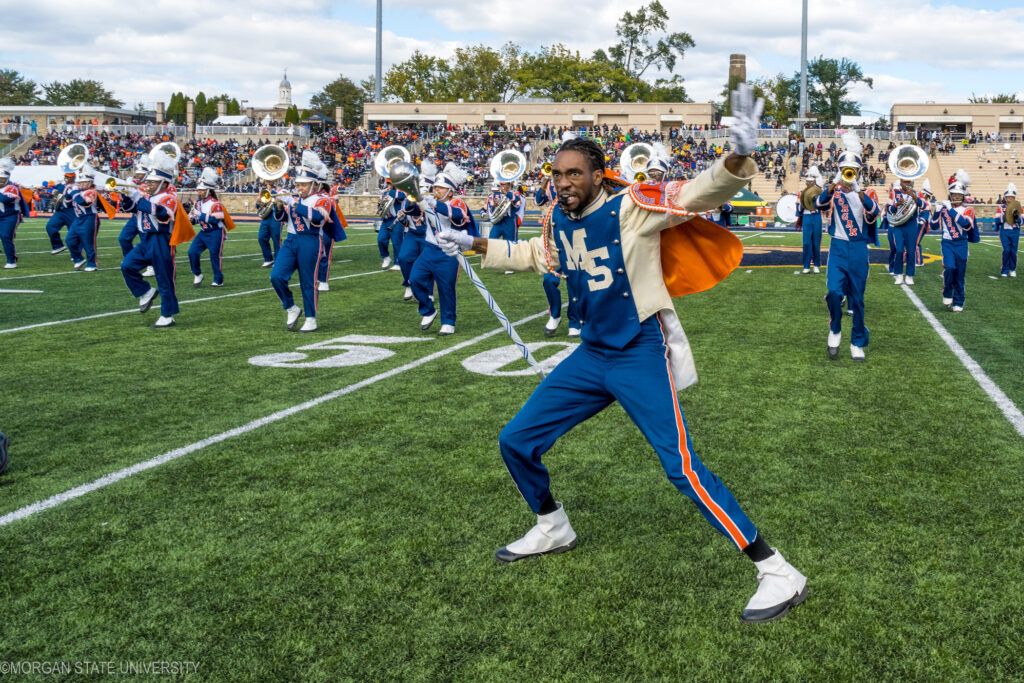
The Magnificent Marching Machine stands at the center of the university’s cultural identity. Known for precision, power, and musical range, the band has performed at professional sporting events, national parades, and major showcases.
At HBCUs, marching bands are tradition bearers. They blend classical discipline with contemporary rhythm. As a result, halftime becomes headline performance.
During homecoming, blue and orange flood the stadium. The drumline reverberates across campus. Alumni stand. Students erupt. In those moments, performance becomes shared memory.
Participation demands rigor equal to varsity athletics. Rehearsals are exacting. Standards are high. However, the reward is legacy — and the continuation of a sound that carries Morgan’s story forward.
An Institution That Endures
More than 150 years after its founding, Morgan State University stands as both historic and forward-looking. It has grown from a church basement into a nationally recognized research HBCU
Over time, the university produced scientists who advanced aerospace technology, entrepreneurs who reshaped economic narratives, lawmakers who influenced federal policy, and athletes who redefined professional sports.
Morgan was built during Reconstruction. The institution endured segregation and later expanded through public investment. Today, it continues to evolve with national reach and global ambition.
On its Baltimore campus, history does not sit quietly. It studies in laboratories, debates in classrooms, competes on fields and courts, and marches in formation.
And in every space it occupies, Morgan State University continues to declare what it has declared since 1867: excellence is not accidental. Preparation is power. The HBCU legacy is still unfolding.
Watch the Spotlight
Morgan State’s legacy deserves more than words on a page. For a full breakdown of its history, athletics, and impact, watch our sports talk spotlight in the video below.


About the Author