
#image_title
 0
0
 0
0
Arizona State walked out of McKale with an 89–82 loss, but nothing about the night felt like a mismatch. For long stretches the Sun Devils went possession for possession with the nation’s top‑ranked Wildcats, moving the ball, stretching the floor, and reminding everyone that when they are locked in together, the gap between them and the elite is far slimmer than the rankings suggest.
First‑Half Fight in Tucson for the Sun Devils
From the opening tip, Arizona tried to lean on its size and reputation, pounding the ball inside and testing ASU’s resolve at the rim. The Wildcats were bigger and deeper, and over 40 minutes that showed up in the margins—extra rebounds, second‑chance points, a steady parade to the free‑throw line. Yet every time it looked like Arizona might finally wrest control of the game, the Sun Devils answered with poise, a made three, a defensive stand, or a composed half‑court possession that quieted the McKale roar just enough to keep the door open.
Diop’s was Sun Devils Backbone in Tucson
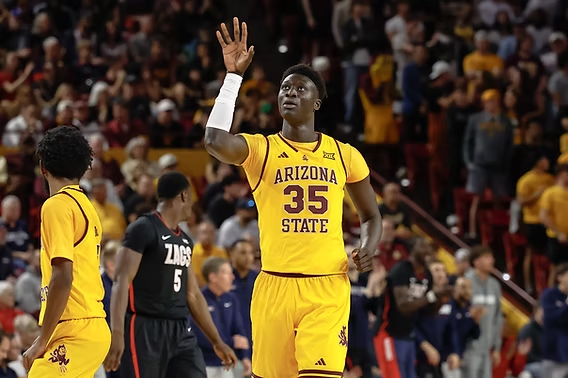
Massamba Diop was the hinge that kept that door from swinging shut early. He did not dominate the box score, but his presence was unmistakable, meeting Arizona’s bigs chest‑to‑chest and forcing them to finish through bodies instead of gliding to uncontested layups. On offense, Diop provided a calming outlet on the block—catching, pivoting, and making strong moves or kick‑outs that prevented the Sun Devils from drifting into purely perimeter‑dependent basketball, giving the team a steady interior backbone against the No. 1 offense in the country.
A Tale of Two Halves for Peat
Early Struggles
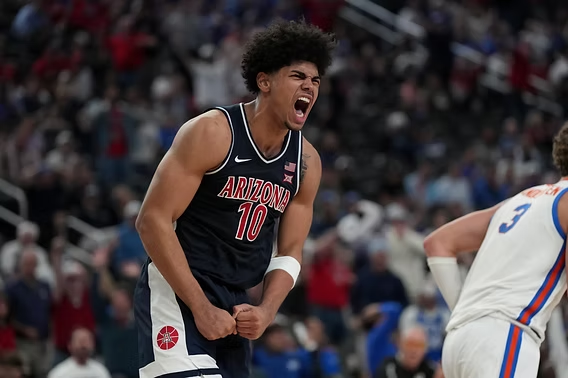
Still, Arizona eventually made its push, and the game’s rhythm shifted after halftime. For Koa Peat, that shift felt personal; the freshman spent the first half searching for his touch, laboring to a 2‑for‑8 start that produced only 8 points and more frustration than rhythm.
Second‑Half Resurgence
After the break, though, he stepped out of the locker room looking like a different player—calm, decisive, and ruthless whenever he saw a crack in the defense. Peat attacked closeouts, buried mid‑range jumpers, and ducked into the post for power finishes, stacking bucket on bucket until his early struggles were a distant memory; he did not miss a shot in the second half, going 7‑for‑7 to close the night 9‑for‑15 with 24 points, the kind of response that signals a star learning how to impact a game even after a rough start.
Sun Devils Moe Odum’s Clutch Blueprint
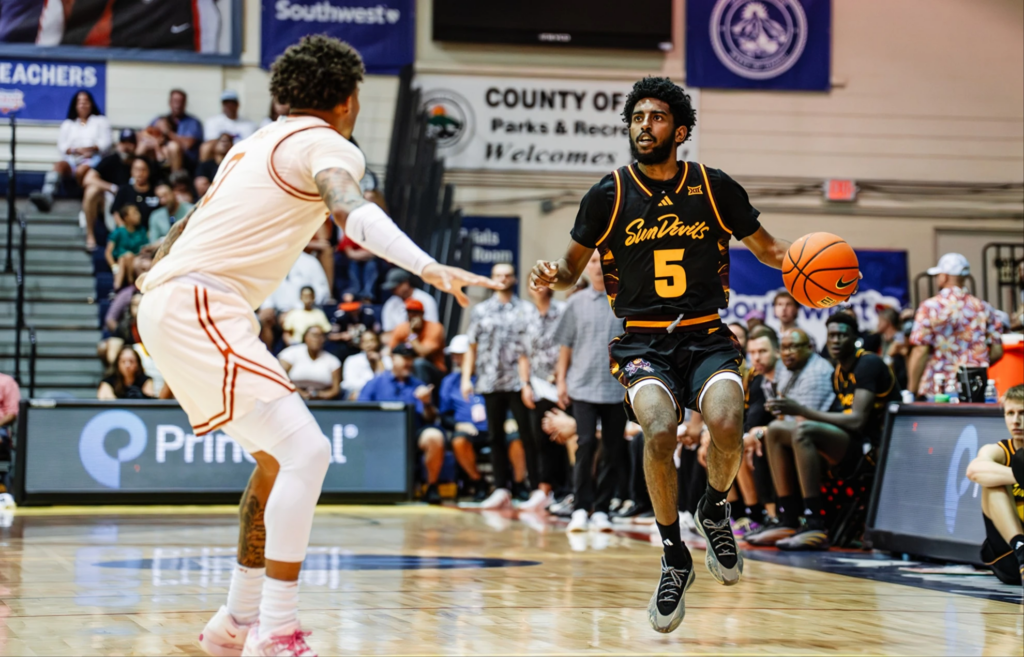
On the other sideline, Moe Odum wrote his own second‑half story. While Arizona’s size was tilting the rebounding and free‑throw battles, Odum kept tilting the scoreboard back with timely shot‑making and fearless drives. He finished with 23 points, and the striking part wasn’t just the total—it was that 18 of those came after the break, many of them in possessions where a miss might have broken ASU’s grip on the game, as he snaked into the lane, rose confidently from deep, and calmly steered the offense when the noise peaked.
Margins That Decided It
And yet, as often happens in these near upsets, the numbers around the edges told the story of why the upset never fully materialized. Arizona owned the glass, finishing the night with an 11‑rebound edge that produced too many extra looks for an offense that rarely needs second chances. The Wildcats also lived at the line, building a 15‑attempt advantage that slowly, almost imperceptibly, widened the margin when the possessions tightened in the final minutes—just enough to offset Arizona State’s barrage from deep, where the Sun Devils drilled 11 threes to Arizona’s 4.
Awaka Changes the Game Off the Bench

If Arizona’s starters set the framework of the night, Tobe Awaka exploded through it. Coming off the bench, the sixth man turned the second half into his personal showcase, pouring in a game‑high 25 points while never looking rushed or forced. He scored from everywhere—soft touch on short rolls, patient post‑ups, hard drives into contact—and each basket felt like a small momentum theft from an Arizona State team that kept refusing to go away.
What made Awaka so devastating was how perfectly his strengths attacked ASU’s thinnest margin. He relentlessly sought out contact, lived in the paint, and turned defensive stops into free‑throw opportunities, helping Arizona build the decisive edge at the line that separated the two teams. In a game where the Sun Devils buried nearly three times as many threes and repeatedly answered runs, Awaka’s bench production gave the Wildcats a fresh, physical scoring option that Arizona State never fully solved, underscoring how narrow the path to an upset becomes when a title contender’s sixth man plays like a star.
A Statement in Defeat
In the locker room afterward, the scoreboard said defeat, but the film will say something more encouraging. It will show Diop standing his ground against elite frontcourt size, Peat transforming a cold start into a signature half, and Odum delivering under pressure in one of the toughest environments in college basketball. It will also show a group that trusted one another, moved the ball, and defended as a unit well enough to make the No. 1 team in the country sweat deep into the night—a reminder that when the Sun Devils play as a team, connected and unselfish, they can walk into any gym and know the game is going to be a fight.


About the Author