#image_title
 0
0
 0
0
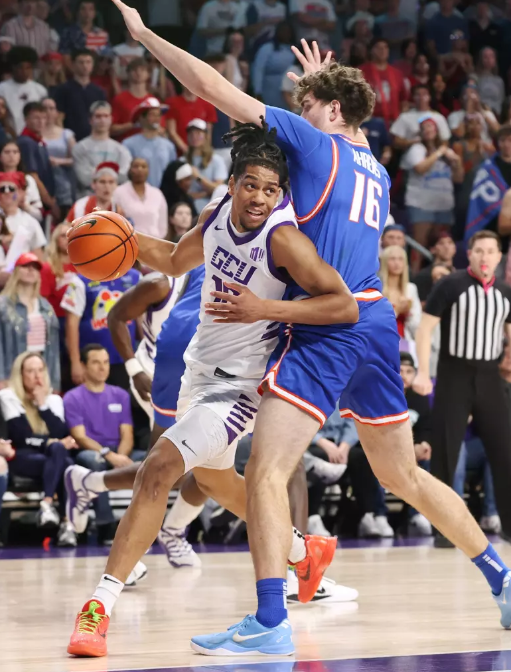
GCU looks positioned to control tonight’s matchup with Air Force, with the Lopes’ balanced offense and disruptive defense creating a significant edge at Global Credit Union Arena.
Setting the stage for GCU vs Air Force
Grand Canyon enters at 14–7 and 7–3 in Mountain West play, while Air Force comes in at 3–18 overall and winless in league action. This is the first-ever meeting between the programs and comes on GCU’s home floor, where the Lopes have routinely leaned on their depth, physicality, and a raucous atmosphere. Betting models reflect the mismatch, installing GCU as a heavy favorite with a spread north of 20 points and assigning the Lopes roughly a 99% win probability.
When GCU has the ball
The Lopes’ offense grades out at an adjusted efficiency of 110.6 points per 100 possessions against Division I opponents, well above the national average and a strong number against an Air Force defense allowing opponents to score at a 114.3 efficiency clip. Grand Canyon’s effective field goal percentage sits at 52.0%, buoyed by solid finishing at the rim and enough shooting to keep defenses honest, while Air Force’s opponents hit 54.8% in effective field goal rate, one of the key pressure points GCU will attack. The Lopes also carry a clear edge on the glass with a 31.6% offensive rebounding rate against a Falcons defense that allows opponents to reclaim 30.9% of their own misses.
Turnovers are one area where GCU can truly separate, as the Lopes turn the ball over on 17.8% of trips but face an Air Force defense that forces giveaways on just 15.2% of possessions. If GCU plays through contact and earns trips to the line—where their free throw rate (FTA/FGA) sits at 32.8% versus Air Force’s 32.9% allowed—they can stack efficient possessions and put this game out of reach early. Expect Grand Canyon to test Air Force’s help-and-recover principles by spreading the floor, driving gaps, and generating inside-out threes.
GCU personnel to watch
Jaden Henley has emerged as GCU’s go-to scoring option, leading the Lopes with 17.1 points per game and coming off a 20-point outing in the win over Boise State. Henley’s ability to attack off the bounce and play through contact fits perfectly against a Falcons defense that struggles to stay in front of dynamic guards. Nana Owusu-Anane anchors the frontcourt with 8.6 rebounds per game and gives Grand Canyon a strong two-way presence on the glass and as a finisher in ball-screen actions.
Brian Moore Jr. stabilizes the perimeter as the team’s primary facilitator, averaging 2.5 assists per game and helping keep the offense organized in both half-court and transition. Role players like Makahi Williams and Efe Demirel complement the core with spacing and secondary playmaking, rounding out a rotation that can apply constant pressure over 40 minutes. With bench minutes north of 29% of total playing time and bench scoring over 31% of the Lopes’ points, GCU’s depth should be another key advantage as the game wears on.
When Air Force has the ball
Air Force’s offense sits at an adjusted efficiency of 95.4 points per 100 possessions, a bottom-tier mark nationally and well below Grand Canyon’s defensive efficiency of 101.0. The Falcons’ effective field goal percentage is just 49.0%, and they now run into a GCU defense that allows opponents an eFG% of only 50.2% while contesting shots at all three levels. Air Force’s offense also leans into longer possessions—an average possession length of 19.7 seconds—while GCU is comfortable grinding in the half-court with opponents’ possessions averaging 18.0 seconds.
Turnovers and physicality are looming issues for the Falcons, who cough it up on 22.1% of their trips, far worse than GCU’s opponents’ 16.4% turnover rate. Grand Canyon generates steals on 9.0% of defensive possessions and blocks 8.2% of opponent attempts, signaling a defense that can blow up actions late in the clock. If Air Force can’t reliably get into its Princeton-based motion and counters, possessions will end in late-clock jumpers over length or live-ball turnovers that ignite GCU’s transition game.
Falcons players and matchup keys
Caleb Walker is Air Force’s leading scorer at 11.9 points per game, doing most of his damage inside the arc, where he shoots 53.2%, but he will be out of tonight’s contest. The Falcons will have to lean heavily on guard Kam Sanders, who adds 11.5 points and a team-best 3.1 assists, while wing shooter Lucas Hobin averages 11.1 points with heavy volume from three, hitting 45 threes at 32.4%. Forward Eli Robinson is the Falcons’ best rebounder at 5.0 boards per game and will be tasked with battling Owusu-Anane and GCU’s front line for every miss.
For Air Force to hang around, it must turn this into a half-court chess match: limit turnovers, hit perimeter shots, and keep Grand Canyon off the offensive glass. The Falcons take threes on nearly 40.1% of their attempts and get 28.7% of their points from beyond the arc, so any upset bid probably hinges on a hot shooting night from Sanders, Hobin, and Ethan Greenberg. But with the statistical profile tilting heavily toward GCU in efficiency, depth, and physicality, the Lopes have every opportunity to turn tonight into another statement performance at home.
Projection: Grand Canyon 82, Air Force 58
A spread hovering in the mid‑20s and a total around 135.5 points point to a comfortable GCU win in front of the home crowd. Air Force’s scoring struggles and turnover issues make it hard to keep pace with a Lopes team that has been efficient at both ends and dominant at Global Credit Union Arena, so a result in the low‑80s to high‑50s range fits both the analytics and the market.


About the Author